

Introduction
Channel partner loyalty is becoming much more than a way to reward distributors, dealers and resellers. Businesses increasingly need to understand partner performance, identify growth opportunities and keep their networks engaged.
But running a channel partner loyalty program across many regions, product lines and partner segments can be challenging. Sales data can be scattered across systems, incentive structures can be difficult to manage, and the same engagement strategy doesn’t work for every partner.
That’s where artificial intelligence can step in.
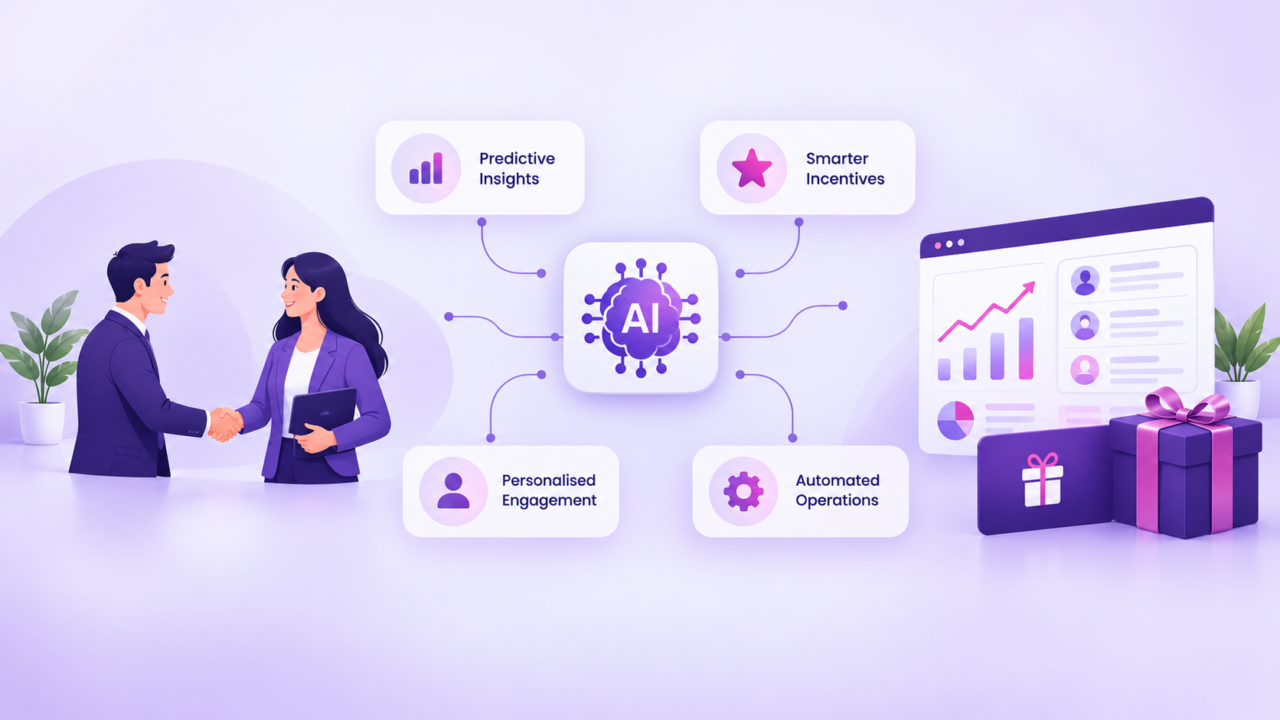
Artificial intelligence can enable a smarter approach to channel loyalty, helping businesses interpret historical sales data, spot emerging patterns and make better informed decisions. Businesses can move toward programs that respond more closely to partner behavior, performance rather than relying on manual analysis alone and standardized incentive structures.
Why Channel Partner Loyalty Needs a Smarter Approach
Benepik’s Channel Partner Loyalty: Trends & Challenges Report 2025, covered by The Economic Times, reported that 46% of companies surveyed struggled with low channel partner engagement. The report highlighted challenges including complicated reward redemption, poor communication and manual incentive management.
The problems exist interlinked in nature. It may become hard for partners to comprehend the scheme, reward redemptions are inconvenient, or incentives are irrelevant to their business goals, then the engagement can be affected.
While traditional reporting tells us about the events that have occurred in the past, to understand why the performance has changed and to get to know the potential as well as the concerned partner, deeper analysis may be required.
This is how an AI-driven channel partner loyalty program can help bridge the gap by making partner engagement, incentive management, and performance management more relevant to the business.
What Gartner's Research Says About AI in Channel Partnerships
Enhance Partner Ecosystem Performance Using AI-Powered Incentive Programs, from July 2026 by Gartner, focuses on incentive programs that use data and artificial intelligence technology to create alignment between business goals and those of its partners. The idea is that incentivizing can be used more strategically.
In another study, How AI Is Transforming Partner-Led Revenue Growth, published by Gartner in September 2026, the difficulty of working with a large number of partners who generate small amounts of revenue is highlighted. One way to address this problem through AI-driven partner management and enablement to shift team members’ attention toward high-value partners.
Using the AI technology to analyse the performance of your partners in terms of how well they meet your business goals could help you identify trends, opportunities and allocate resources in a way that would make an impact.
This could involve creating better incentives, support and understanding of channel loyalty programs.
6 Ways AI Can Transform a Channel Partner Loyalty Program
1. Predict Sales Performance Before Problems Escalate
AI can use past sales performance, trends, and individual product performance to predict future sales numbers for individual partners, territories, and geographic regions. This can be helpful in helping the sales team see any potential problems, changing demands, and what their next steps might be.
If the sales performance of a particular partner does not meet the standards, then extra attention, a new product line, or an examination of the market environment may be required.
It is important to be proactive about performance management so that businesses can spot any potential issues before they arise.
2. Set More Realistic Targets and Identify Growth Opportunities
AI can help businesses assess historical performance, remaining targets and territory-level opportunities when planning and evaluating sales goals.
It can also help identify underdeveloped territories, promising product categories and partners who may have opportunities to expand their business.
For channel partner loyalty programs, this creates an opportunity to connect incentives more closely with business potential and achievable outcomes rather than relying entirely on standardised targets.
3. Turn Partner Data into Actionable Insights
AI can combine different signals to surface performance trends, highlight anomalies and give a clearer picture of what the partner is doing.
For example, falling sales and diminished campaign engagement could signal a need to engage more closely. Similarly, a product performing well in one territory may indicate an opportunity worth exploring in another.
Artificial intelligence can help program managers to move beyond routine reporting and make better informed decisions about partner engagement and program performance by making information easier to interpret.
4. Help Sales Teams Choose Their Next Best Action
For salespeople having large networks of partners, it is important to determine how best to utilise their time and which interventions can prove effective in this respect.
With the help of AI, the business can take informed decisions about how to engage the partner by analysing the performance, engagement, demand for products and target achievement status of the partner.
In certain cases, the intervention for the partner could be anything ranging from a follow-up call, training for the partner, an appropriate incentive, resolution of some issue and even meeting with the partner by the relationship manager.
It is the relevance of the approach that is important rather than applying a generic solution to all partners.
5. Personalise Rewards, Incentives and Partner Engagement
Not every partner responds to the same reward, incentive or communication. Their preferences, purchasing patterns, engagement history and business objectives can influence what motivates them.
With the help of artificial intelligence, businesses can learn from those differences and incorporate them into making more relevant reward suggestions, incentives and communication strategies.
For instance, the history of redemptions may give businesses valuable information on reward preferences while the participation of the partner in the campaigns and their success with products may tell something about incentives.
Personalization is possible also in terms of communication.
Businesses can know what type of information should be provided, what channels should be used and when it might be appropriate to communicate with partners.
The end result is a possibility to build up the channel partner loyalty program for each partner while ensuring that the incentives will serve business purposes.
1. Detect Unusual Claims and Potential Scheme Abuse
AI is capable of analysing transaction trends and detecting activity that doesn’t align with expected behavior. Such signals could assist in helping the programme administrator detect cases that need to be reviewed further.
Examples of such activities include multiple invoicing or suspicious claims patterns that need verification prior to approving any rewards.
Such solutions should augment and not replace human review process, as any suspicious transaction does not necessarily imply fraudulent activity, and proper verification and approval processes are still required.
This way, by increasing transparency of the programme, businesses would move towards more efficient review process and fair treatment of legitimate partners.
What Benepik's Channel Loyalty Platform Brings to the Foundation
Data-driven insights will be valuable only if they are integrated with a proper channel loyalty program. Companies require a base to facilitate partner involvement, incentives management, and performance monitoring before making the best use of more sophisticated methods.
Benepik’s Channel Loyalty solution includes capabilities such as campaign management, incentive calculation, leaderboards, a rewards catalogue and real-time analytics. These capabilities provide a programme-management foundation around which businesses can organise partner engagement, incentives and performance monitoring.
With the growth of channel loyalty, the challenge for companies is to leverage the programme management framework in place and exploit partner data to uncover trends and develop more focused engagement programmes.
This approach will enable firms to link the results from programme activity to business outcomes and learn both how well programmes perform and where there may be areas for improvement.
What Businesses Need Before Implementing AI in Channel Loyalty
The effectiveness of AI in channel loyalty depends on more than the technology itself. Businesses also need reliable data, clearly defined objectives and processes that turn insights into meaningful action.
Clear objectives: Businesses should identify the problems they want to address, whether that means improving engagement, understanding sales performance, identifying growth opportunities or reducing manual work.
Human oversight: Predictions and recommendations should inform decisions rather than automatically determine sensitive outcomes, particularly when reviewing claims or potential scheme abuse.
Reliable data: Historical sales, partner activity, incentive records and reward redemption data should be sufficiently accurate and consistent to support useful analysis.
Connected systems: Information from sales, inventory, CRM and loyalty platforms can provide a more complete picture of partner activity when relevant integrations are available.
Performance measurement: Businesses should evaluate whether their initiatives contribute to outcomes such as improved partner participation, target achievement, reward redemption, incremental sales or more efficient programme management.
A focused approach can help businesses identify where AI may provide the greatest value without adding unnecessary complexity to existing processes.
The Future of Channel Partner Loyalty
Channel Partner Loyalty at Benepik is not limited to rewards for partners; rather, it is about helping businesses manage their relationship with partners in a way that helps them increase engagement and align incentive programs with their overall goals.
As partner networks continue to grow, businesses require new tools that would allow them to gain more visibility into the performance of partner networks and make better decisions. The Channel Loyalty platform from Benepik allows businesses to combine all aspects of incentive and loyalty programs in one package, including campaign management, incentive calculations, leaderboards, rewards, and performance analytics.
The future of channel partner loyalty involves the improved usage of partner data for tracking changes in behaviour and identifying new growth opportunities, as well as making engagement more relevant to the partner and its business.
Using Benepik, businesses can develop a more connected approach to channel partner loyalty, combining program management, performance insight, and partner engagement.
Let Us Connect