

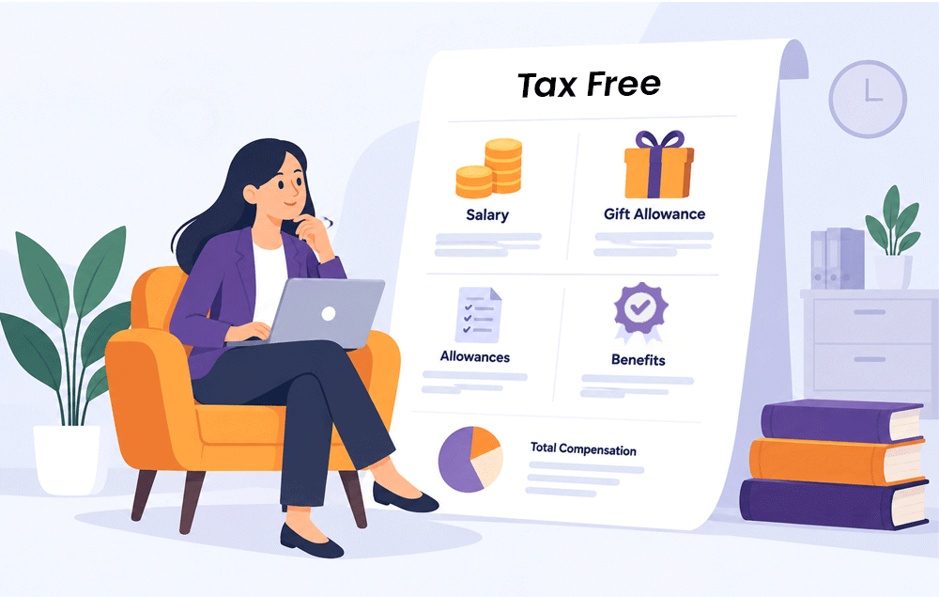
For years, the tax-free gift allowance for employees was fixed at 5,000 a year. The amount was too small to build a strategy around it. It could only suffice one or two occasions; a Diwali reward, a birthday voucher, maybe a small performance incentive.
That changes now. The Income Tax Rules 2026 have tripled the employee gift tax exemption limit to ?15,000 per employee, per year. On paper, it’s a compliance update. In practice, it’s an opportunity for HR and rewards teams to finally build a gifting strategy that resonates with their people.
What has exactly changed
Under the new employer gift tax rules, effective from Tax Year 2026-27 (April 1, 2026 onwards), the perquisite value of gifts, vouchers, and tokens given by an employer is treated as nil as long as the total stays within ?15,000 in the financial year. Anything more than that will be taxable.
A few things HR teams need to be aware of:
- It’s an aggregate limit, not a per-gift limit. A festival voucher, a birthday gift card, and a spot-recognition token all count toward the same amount of ?15,000.
- Cash is still fully taxable, from rupee one. The exemption applies only to non-cash gifts, vouchers, and tokens. Cash awards and cash-equivalent payouts are not eligible for tax exemption.
- One rupee over, and the whole thing is taxed. This isn’t a slab system. Structure a ?14,000 gifting calendar well, and it’s completely tax-free. Add one uncoordinated ?3,000 gesture, and the full ?17,000 becomes taxable salary.
That last point is the one most companies will get wrong first.
Why ?5,000 never got organizations excited but ?15,000 will
At ?5,000, gift allowance under the old corporate gifting tax rules inclined a lot towards a one-time gifting gesture instead of an employee experience strategy. It couldn’t fund a meaningful reward, so most companies didn’t bother designing around it. HR knew the rule existed, applied it inconsistently, and rarely explained it to employees at all.
At ?15,000, the calculation changes. The amount is enough to cover a festive gift gesture, a birthday reward, a few peer recognitions, and a milestone celebration across the year. All fully tax-free, it’s a great policy change that benefits the employee’s pocket and the employer’s payroll narrative at the same time.
Turning a tax rule into a rewards strategy
The organizations that get ahead here won’t just raise a number in their HR gifting policy document. They’ll rebuild their Reward Strategy around it:
- Build an annual gifting calendar, not one-off gestures. Spread the rewards across festivals, birthdays, work anniversaries, and performance moments across the year, and budget each in the beginning of the year.
- Track the aggregate, not the occasion. Every gift needs to be logged against a single running total per employee. This is important when multiple teams: HR, managers, sales are all gifting independently.
- Keep it non-cash by design. Since only non-cash employee gifts like vouchers qualify, and not cash, the gifting mode matters as much as the value. Digital gift cards and reward points structured correctly protect the exemption; a cash bonus as a “gift” doesn’t.
- Communicate the benefit to employees. Most employees have no idea their festive voucher is tax-free, or that the limit just tripled. Making this visible turns a compliance detail into a benefit and a talking point for why the company’s rewards program is worth paying attention to.
- Let the platform do the counting. Manual tracking across HR, managers, and business units is where breaches happen. An employee rewards and recognition platform that aggregates every gift, voucher, and recognition moment against the ?15,000 limit, automatically, in real time removes the guesswork entirely.
“The increase in the gift threshold is more than a compliance change; it creates an opportunity for HR to rethink how gifting can contribute to the employee experience. Tripling the limit gives companies greater flexibility to make rewards more meaningful, while still keeping compliance at the centre.” – Saurabh Jain, Founder, Benepik
Why Gift Cards are the way to go
With the strategy it is also important to know which mode of gifting is the best suitable for the reward strategy. Hampers spoil, have to be shipped, don’t offer choice and rarely feel personal. Cash fails the exemption entirely. Gift cards solve all of it at once.
They’re non-cash by definition, so they align with the exemption without any ambiguity for payroll or auditors. They’re instant to issue and easy to reconcile. A digital gift card can be sent in seconds and logged against an employee’s running total the moment it’s issued, which is exactly the aggregate tracking the new rule demands. And because the employee chooses what to redeem it for, the same ?15,000 budget feels like a real gift rather than a generic hamper, without HR ever having to know or guess what each person actually wants. For an allowance that now has real money behind it, a gift card platform is the simplest way to keep every rupee both compliant and genuinely appreciated.
The takeaway
A tax rule rarely changes how employees feel about their workplace. This one might. ?15,000 is enough to make gifting feel intentional rather than incidental but only for organizations that treat it as a system to design, not a limit to remember. The ones that get their tax-free gift allowance for employees structured well this year with the right gifting calendar, tracking, mode and communication, will turn a Finance Ministry notification into a genuine employee experience win.
Let Us Connect