
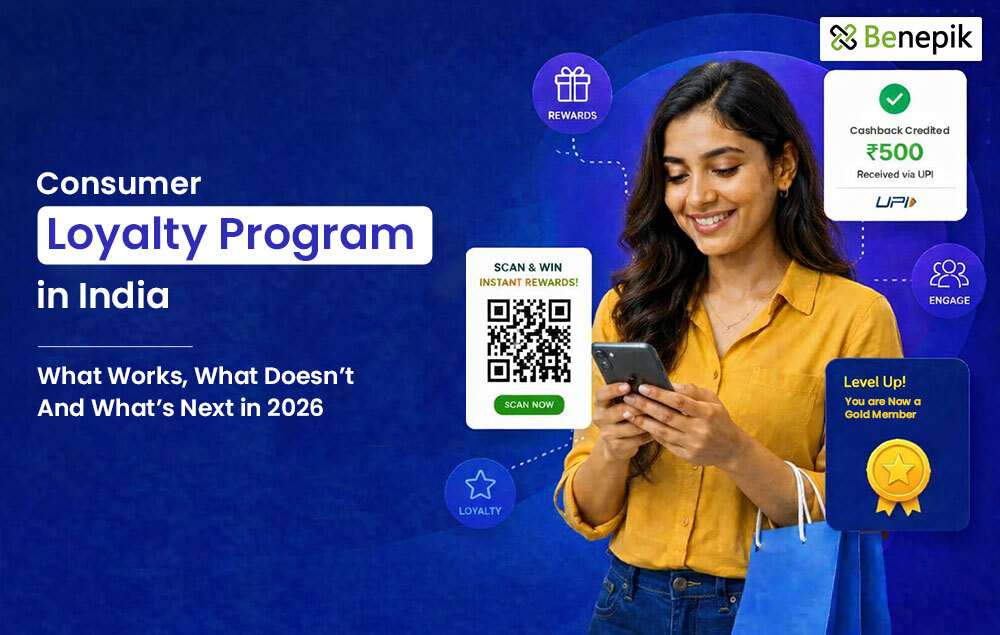
Loyalty in 2026 is now no longer about Points.
Indian brands are spending more than ever to acquire new consumers, yet consumers retention remains one of the biggest growth challenges across industries.
Consumers today have endless choices, shorter attention spans, and higher expectations. They expect brands to understand their preferences, reward their loyalty instantly, and engage with them on channels they already use.
This is why a modern consumer loyalty program strategy looks very different from traditional loyalty initiatives.
Today’s leading brands are investing in loyalty programme solutions that combine first-party data collection, QR-based engagement, gamification, WhatsApp interactions, and instant rewards. Whether you’re evaluating a customer loyalty platform or looking for a scalable consumer engagement platform, the objective remains the same: transform one-time customers into repeat buyers and long-term advocates.
The reality is simple. Consumers don’t stay loyal to a brand because they offer discounts. They stay loyal because of the consistent values these brands create for them. The brands winning in 2026 are not the ones running the biggest offers but the ones who are creating the most engaging customer experiences.
The State of Consumer Loyalty in India in 2026
The loyalty landscape is going through a major shift.
As acquisition costs continue to rise and competition intensifies across categories, businesses are shifting their focus from short-term promotions to long-term engagement strategies.
Consumers are no longer impressed by generic offers or delayed rewards.
Instead, they expect:
- Personalised experiences
- Mobile-first interactions
- Instant gratification
- Meaningful rewards
- Seamless participation
- Flexibility in Reward Redemption
For brands, loyalty is becoming far more than a retention tool. It is now a strategic growth lever that helps organizations:
- Increase repeat purchases
- Build first-party customer databases
- Reduce acquisition costs
- Improve customer lifetime value
- Strengthen customer relationships
- Drive measurable engagement
Now loyalty has evolved from being a marketing initiative to a business strategy.
Why Most Loyalty Programs Fail
Despite significant investments, many loyalty programs fail to deliver meaningful results. The problem is not in the reward budget but how the program is designed.
Points Fatigue
Consumers today are enrolled in multiple loyalty programs. Many accumulate points but never redeem them because the rewards feel too generic or insignificant. No one wants to accumulate all the points to just get a keychain at the end!
When customers don’t see immediate value, participation drops.
Generic Rewards
Not every customer is motivated by the same reward. A working professional, a homemaker, and a first-time buyer are likely to respond differently to the same reward.
Programs that fail to personalize rewards often struggle to maintain engagement.
Poor User Experience
If participation requires lengthy registrations, app downloads, complicated redemption journeys, or multiple verification steps, customers lose interest quickly.
The best loyalty programs are that are simple to use and reduce friction at every stage.
Delayed Rewards
Consumers have become accustomed to instant transactions. Waiting days or weeks to receive a reward significantly reduces its value.
Immediate gratification drives stronger engagement than larger delayed rewards.
Fraud and Lack of Validation
One of the most overlooked reasons loyalty programs fail is fraud.
Duplicate claims, fake registrations, unauthorized redemptions, and dealer-level manipulation can significantly impact campaign effectiveness and profitability.
Without proper validation mechanisms, loyalty programs can quickly become vulnerable to misuse.
The 2026 Consumer Loyalty Framework
The most successful loyalty programs are built around four foundational pillars.
Rather than focusing solely on rewards, brands need to create a complete engagement ecosystem.
- Trigger
What customer behaviour are you trying to influence?
Examples include:
- Product purchases
- Repeat purchases
- Referrals
- App downloads
- Product registrations
- Service activations
- Loan disbursements
- Milestone achievements
- Reward
What motivates your customers to take action?
Rewards may include:
- Cashback
- Digital gift cards
- Merchandise
- Loyalty points
- Vouchers
- Exclusive experiences
- Validation
How do you ensure authenticity?
Validation mechanisms may include:
- OTP verification
- QR code validation
- Unique serial numbers
- Invoice verification
- KYC checks
- Duplicate claim prevention
- Experience
How memorable and personalised is the journey for your customer? Modern consumers engage with experiences, not just transactions.
This is where gamification becomes powerful.
Examples include:
- Spin-the-Wheel
- Scratch Cards
- Milestone Rewards
- Tier-Based Loyalty
- Referral Challenges
- Surprise Rewards
The strongest loyalty programs combine all four pillars seamlessly.
What Actually Works in Consumer Loyalty Programs Today
QR-Based Loyalty Programs
The rise of the QR code loyalty programme India model has fundamentally transformed consumer engagement.
Instead of filling lengthy forms or managing physical coupons, consumers can simply scan a code and participate instantly.
For brands, QR-based engagement provides:
- Faster participation
- Better campaign visibility
- Improved data collection
- Reduced friction
- Stronger engagement rates
- Instant UPI Rewards
The faster the reward, the stronger the engagement.
Consumers increasingly expect rewards to be delivered immediately after completing a qualifying action.
UPI-powered rewards provide:
- Instant gratification
- Higher redemption rates
- Increased participation
- Greater transparency
- Improved customer satisfaction
Gamification Loyalty Programs
A modern gamification loyalty programme turns routine transactions into memorable experiences.
Consumers naturally respond to anticipation, achievement, and surprise.
Some of the most popular gamification elements are,
- Spin-the-Wheel
- Digital Scratch Cards
- Milestone Unlocks
- Referral Challenges
- Leaderboards
- Tier-Based Rewards
Gamification doesn’t just reward behaviour. It encourages customers to repeat it.
WhatsApp-Native Loyalty
Consumers already spend a significant amount of time on WhatsApp.
Rather than forcing customers to download another app, brands are increasingly bringing loyalty journeys directly to WhatsApp.
This allows organizations to:
- Onboard customers
- Verify participation
- Deliver rewards
- Share updates
- Run campaigns
- Collect feedback
All through a familiar channel.
Refer-and-Earn Programs
Referral-based loyalty remains one of the most effective acquisition and retention strategies.
By rewarding both the referrer and the referred customer, brands can create sustainable, low-cost growth engines that continue generating value long after a campaign ends.
The Hidden Challenge: Pilferage in Loyalty
A loyalty program that cannot validate participation is not a loyalty program. It’s a big budget leakage risk.
Common Dealer-Level Fraud Risks
- Duplicate customer registrations
- Fake customer records
- Reward diversion
- Multiple claims against a single purchase
- Unauthorized redemptions
Common Consumer-Level Fraud Risks
- Duplicate claims
- Fake invoices
- Shared QR codes
- Multiple account creation
- Referral abuse
Why Loyalty Is Becoming a First-Party Data Strategy
The brands generating the highest ROI from loyalty initiatives are not simply rewarding transactions- they are using loyalty programs to understand customer behaviour, predict future purchases, and create highly personalised engagement journeys.
Every interaction generates valuable insights.
Brands can understand:
- Purchase frequency
- Product preferences
- Regional demand patterns
- Campaign effectiveness
- Reward preferences
- Customer segments
As privacy regulations evolve and third-party data becomes less reliable, loyalty programs are becoming one of the most effective ways to build rich first-party data ecosystems.
Industry Examples: How Loyalty Programs Deliver Results Across Industries
A successful consumer loyalty program strategy looks different across industries because every business is trying to influence a different customer behaviour.
FMCG: Driving Repeat Purchases at Scale
For FMCG brands, the challenge is not acquiring customers, it’s encouraging repeat purchases.
Using a customer loyalty platform, brands can reward consumers through QR scans, cashback campaigns, vouchers, and gamified experiences while building direct relationships and collecting first-party data.
Business Impact:
- Increased repeat purchases
- Better customer visibility
- Improved brand recall
- Stronger customer lifetime value
BFSI: Building Engagement Beyond Transactions
Banks, NBFCs, insurers, and fintech companies often struggle to maintain engagement after onboarding.
A modern consumer engagement platform helps brands reward repayments, loan disbursements, referrals, and digital adoption journeys.
Business Impact:
- Improved retention
- Increased referrals
- Higher product adoption
- Better customer satisfaction
Retail & E-Commerce: Creating Habit-Driven Loyalty
Retailers compete in an environment where consumers can switch brands instantly.
Using loyalty programme softwares, brands can create tier-based rewards, milestone incentives, personalised offers, and referral campaigns that encourage repeat purchases.
Business Impact:
- Higher purchase frequency
- Lower churn
- Increased order values
- Stronger loyalty
Automotive & Consumer Durables: Extending Customer Relationships
For automotive and durable brands, the real opportunity begins after the sale.
A QR code loyalty programme India strategy can reward warranty registrations, service visits, referrals, upgrades, and accessory purchases.
Business Impact:
- Better post-purchase engagement
- Higher service retention
- Increased upsell opportunities
- Improved customer loyalty
What’s Next for Consumer Loyalty in 2026
The future of loyalty will be more intelligent, predictive, and personalised.
AI-Powered Personalization
Rewards, offers, and campaigns will increasingly be tailored to individual customer behaviour.
Predictive Loyalty
Brands will identify disengaged customers before they churn and proactively intervene.
Hyper-Personalized Engagement
One-size-fits-all rewards will disappear in favour of highly relevant experiences.
WhatsApp-Native Loyalty Ecosystems
Participation, communication, support, and rewards will increasingly exist within conversational experiences.
Loyalty as a Growth Platform
The most successful brands will stop treating loyalty as a campaign and start treating it as a long-term business asset.
How Benepik Helps Brands Build Modern Consumer Loyalty Programs
Benepik helps brands design, launch, and scale consumer loyalty programs that are engagement-led, fraud-proof, and data-driven.
From QR-based participation and OTP validation to gamified campaigns, digital gift cards, referral programs, instant rewards, and real-time analytics, Benepik enables organizations to create meaningful customer experiences while delivering measurable business outcomes.
Whether your objective is to increase repeat purchases, improve retention, collect first-party data, or launch large-scale consumer engagement campaigns, Benepik provides the technology, rewards infrastructure, and expertise needed to make loyalty work
Build Your Consumer Loyalty Programme with Benepik
The future of loyalty belongs to brands that make engagement effortless, rewards meaningful, and every interaction measurable.
Looking to increase repeat purchases, build a verified customer database, launch fraud-proof reward campaigns, and create a scalable loyalty ecosystem?
Build Your Consumer Loyalty Programme with Benepik. Talk to an Expert today.
Let Us Connect